
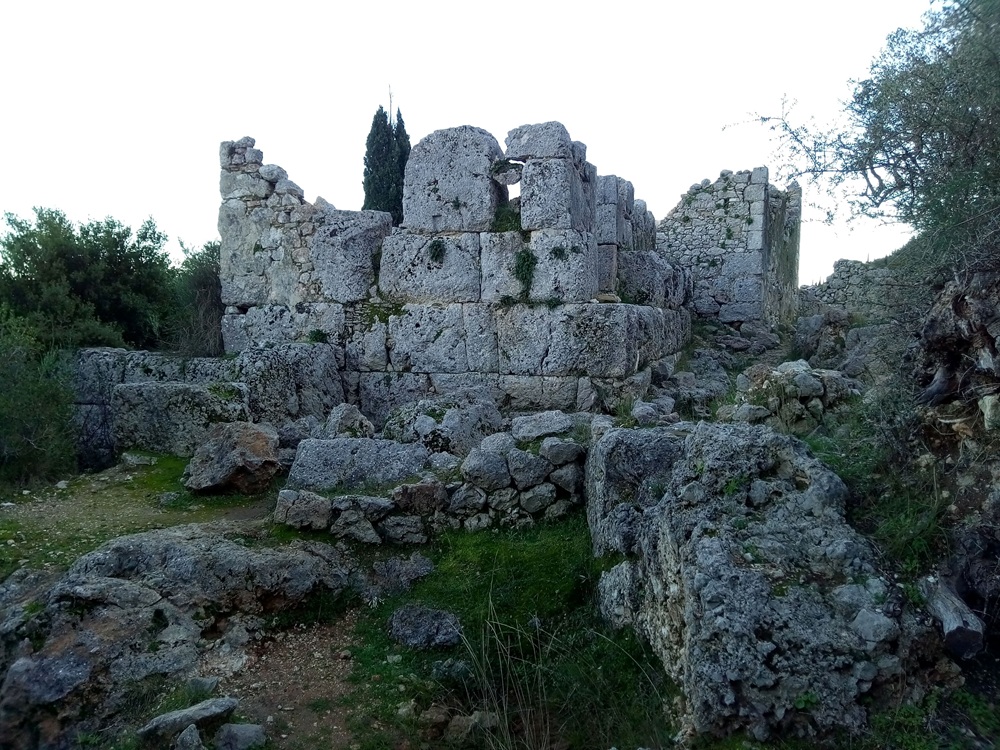
Even in ancient times, the Ionian Sea was a crossroads of the sea routes connecting mainland Greece with the colonies of the Adriatic, Magna Graecia, and the western coasts of Epirus.
The name “Ionian” itself is first mentioned in the 6th century B.C. in a text by Hecataeus of Miletus. However, it is Aeschylus who also refers to the origin of the sea’s name:
Once you came to the Molossian plains and the steep mountain ridge beside Dodona, the home of the prophetic oracle of Thesprotian Zeus, that miracle which defies belief, the talking oak trees, clearly and quite unambiguously saluted you as one who would become a celebrated bride of Zeus.*Is this a memory that gives you some delight? From there, chased by the gadfly’s sting, you rushed along the path beside the sea and reached the mighty gulf of Rhea and from there were driven back by storms. And you should know an inner region of that sea will now, in days to come, be called Ionian, a name to make all mortal men recall how Io moved across it
(Aeschylus, Prometheus Bound, Third Episode, translated by Ιan Johnston)
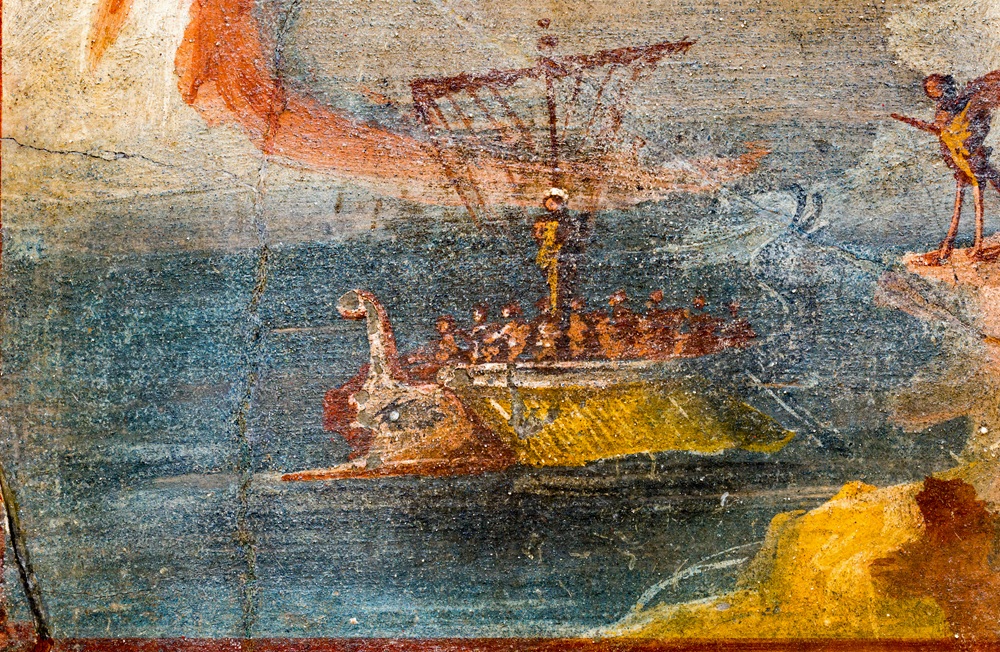
Prometheus recounts to Io the story of her wanderings leading up to their meeting. He refers to her passage through the Ionian Sea, which was formerly known as the “Gulf of Rhea,” and reveals to her that in the future this sea will be named the Ionian Sea so that her passage will not be forgotten.
Aeschylus’s tragedy was written in the 5th century. That is, many years after the composition of the Homeric epics, which date to the Geometric period and reflect the mentalities, myths, and realities of the Mycenaean era. Certainly, the Ionian Islands were not major centers of Mycenaean civilization. However, excavations have unearthed artifacts—primarily tombs but also the remains of buildings—on Kefalonia, Ithaca, Zakynthos, Lefkada, and Corfu. Undoubtedly, the islands maintained trade relations with one another and held a pivotal position in trade and shipping.
During this period, the Greeks are fighting at Troy; during these years, Odysseus wanders through unknown and mysterious lands on his way back to Ithaca. According to Rhapsody II in the “Catalogue of Ships” (a list of ships) that took part in the expedition, mention is made of the islands of the state of the Cephalonians—since the term “Ionian” did not exist at that time—with twelve ships and Odysseus as their leader. “Their leader was Odysseus, equal to Zeus in wisdom, and twelve ships with red-painted sides followed him.” Ithaca is referred to as the seat of the kingdom, where, of course, Odysseus’s palace was located. Odysseus himself describes his homeland in Rhapsody I:
But I dwell in clear-seen Ithaca, wherein is a mountain, Neriton, covered with waving forests, conspicuous from afar; and round it lie many isles hard by one another, Dulichium, and Same, and wooded Zacynthus. Ithaca itself lies close in to the mainland the furthest toward the gloom, but the others lie apart toward the Dawn and the sun—a rugged isle, but a good nurse of young men; and for myself no other thing can I see sweeter than one’s own land.
(Homer’s The Odyssey, Book 9, vers. 21-28, translated by A.T.Murray)
Unlike in Homer’s Odyssey, where Odysseus speaks nostalgically of his homeland, in Virgil’s Aeneid Ithaca is regarded as a cursed place. As Aeneas passes by Ithaca, he cries out: “We are escaping the reefs of Ithaca, the kingdom of Laertes, and we curse the land that raised the cruel (fierce) Odysseus.” Ithaca is the homeland of the cruel—not the resourceful—Odysseus, while the Ionian Sea itself is hostile. Yet in Homer’s Odyssey, the Ionian Sea is also Odysseus’s destination. And facing him, even as his journey nears its predetermined conclusion, will be an inhospitable and storm-tossed sea, which will cast him ashore on the island of the Phaeacians. But it will become peaceful and calm, allowing Odysseus to make his final journey to Ithaca. Ithaca is described in similarly dystopian terms in Nikos Kazantzakis’s reinterpretation in The Odyssey: A Modern Sequel (which is structured around the magical number of 33,333 lines).
Beyond any doubt, Ithaca—as an allegory for “reaching” one’s ultimate destination—has served as a source of inspiration from the poetry of Cavafy all the way to the dawn of modernism (“Ulysses” by James Joyce), and has even inspired writers such as Tolkien in their approach to myths of homecoming.
More recently, in his own adaptation of the Homeric epic, film director Christopher Nolan also drew on the island’s mythical dimensions, but placed greater emphasis on the fact that what truly matters in the end is what awaits us back in Ithaca.




Leave A Comment