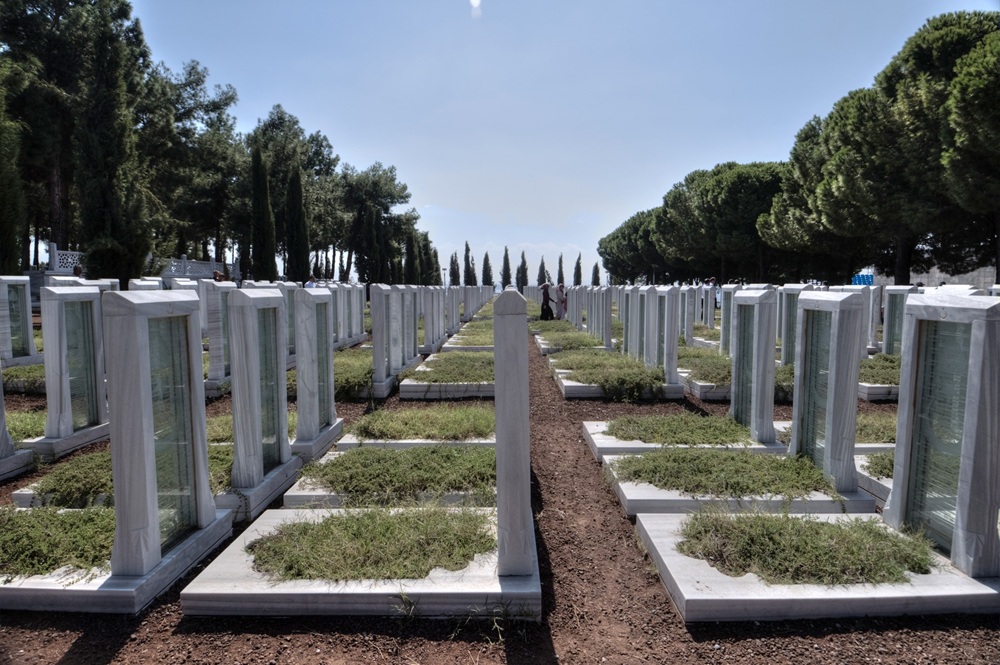
The Gallipoli Campaign is considered one of the military failures of the British and French during World War I. It left a deep impression on the memories of the British, Australians, and New Zealanders. As early as the interwar period, hundreds of veterans took cruises to visit the battlefields and cemeteries, which had been established by the Imperial War Graves Commission (IWGC). By the end of the 20th century, tens of thousands of British, Australians, and New Zealanders participated in Anzac Day and the parade in Çanakkale. The Turks had their own memorials and their own ceremonies, on different dates. There was room for everyone.
Over the past decade, the Erdoğan regime has transformed both the landscape and the nature of these events, building massive museums for every major battle and surrounding all British and ANZAC memorials and cemeteries with replicas of monuments depicting Mustafa Kemal and informational signs, thereby diminishing the presence of the ANZACs and the British on the battlefield. All of this has provoked negative feelings among the CWGC authorities and veterans’ associations, resulting in a decline in visitor numbers.
BIO
Vlasis Vlasidis studied history at the School of Philosophy of Aristotle University of Thessaloniki. He completed his graduate studies and wrote his dissertation at the same school. He has received numerous scholarships, the most significant of which was from the German Marshall Fund. He has published many articles in academic journals on the interwar period. He is a member of the editorial team at www.macedonian-heritage.gr.
He is a research associate at the Macedonian News Agency and teaches the history of Balkan media in the Department of Balkan Studies at Aristotle University of Thessaloniki. His main research interests include media studies, mass communication, new media, the history of media in Greece and the Balkans, propaganda, news agencies, the Cold War, Cold War propaganda, cultural industries, migration and the media, as well as military cemeteries. He is fluent in Greek, English, French, German, and Bulgarian.
***The lecture will be delivered in English, (Thursday 23rd April 2026, 7pm (12pm Athens time). You may attend live here: https://www.youtube.com/@gocmv/featured


Leave A Comment