
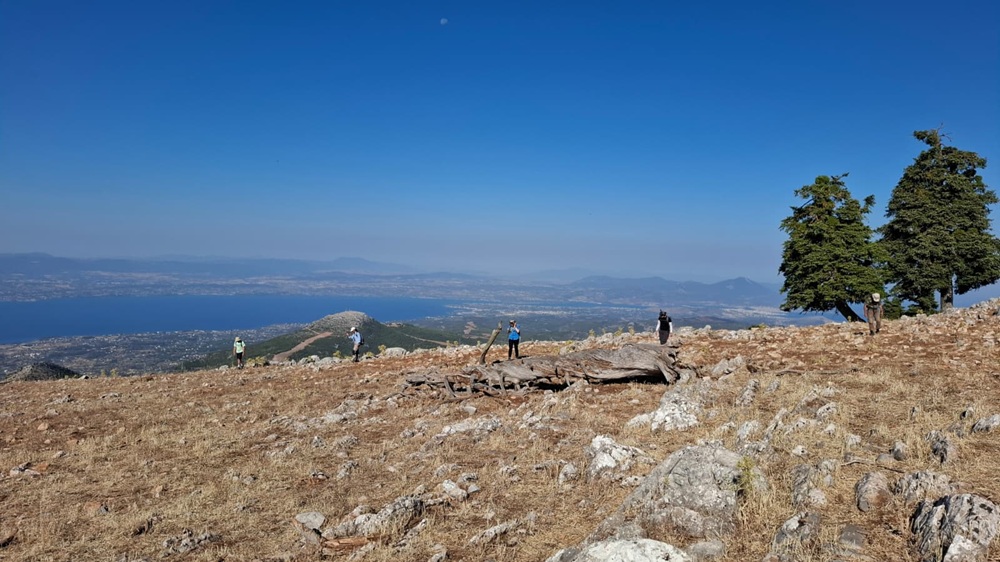
Near the ancient city of Eretria, on the island of Euboea, the Swiss School of Archaeology in Greece (SSAG), in collaboration with the Ephorate of Antiquities of Evia, is conducting a systematic surface survey program in the Eretria plain.
During the period 2021–2025, surface surveys were conducted on the plain stretching between the ancient city of Eretria and the sanctuary of Artemis at Amarynthos. Over an area of 30 square kilometers, more than 200 structures were documented and hundreds of artifacts were collected, providing material evidence of human presence from prehistoric to medieval times. The results of the research provide new insights into the evolution of the landscape over time, contributing to an understanding of how local communities utilized their natural environment and available resources. At the same time, the research sheds light on aspects of the rural landscape, agriculture, and ancient road networks, allowing for the study of the development of the city of Eretria and the integration of the great sanctuary of Artemis into the ancient landscape.
The Methodology of Surface Survey
In the field, surface finds (pottery and tile fragments, stone tools) are recorded, georeferenced, and entered into a Geographic Information System (GIS) to accurately map the distribution of archaeological finds. The research also utilizes modern technologies, such as LiDAR remote sensing, which enables the detection of archaeological remains located beneath vegetation (such as walls, terraces, and ancient roads).
New Findings
The combination of field observations and technological methods has revealed a complex network: approximately ten settlements interpreted as ancient municipalities, farmsteads, cemeteries, quarries, rock-cut olive presses, medieval chapels, and sections of ancient roadways. These investigations offer a new interpretation of the landscape and the historical processes that have shaped it over the centuries, providing valuable data on aspects such as ecology, agriculture, settlement development, the economy, transportation, trade, and social cohesion. At the same time, they serve as a tool for protecting a cultural heritage threatened by modern urbanization.
By combining the results of surface surveys with those from excavations in the city of Eretria and the sanctuary of Artemis at Amarysia, archaeologists are now compiling a unique dataset for studying the region’s development from the end of the Neolithic era to the modern period (19th century).
Each research season involved archaeologists, geomorphologists, and archaeology students from Switzerland, Greece, and other European universities. Under the guidance of experienced researchers, the young archaeologists participate in all stages, from data collection to analysis.
Research project directors: A. G. Simosi (Honorary Curator of Antiquities), S. Fachard (Hellenic Archaeological Society). Field coordinators: O. Kyriazi (National Archaeological Service), Ch. Chezeaux (Hellenic Archaeological Society)


Leave A Comment