
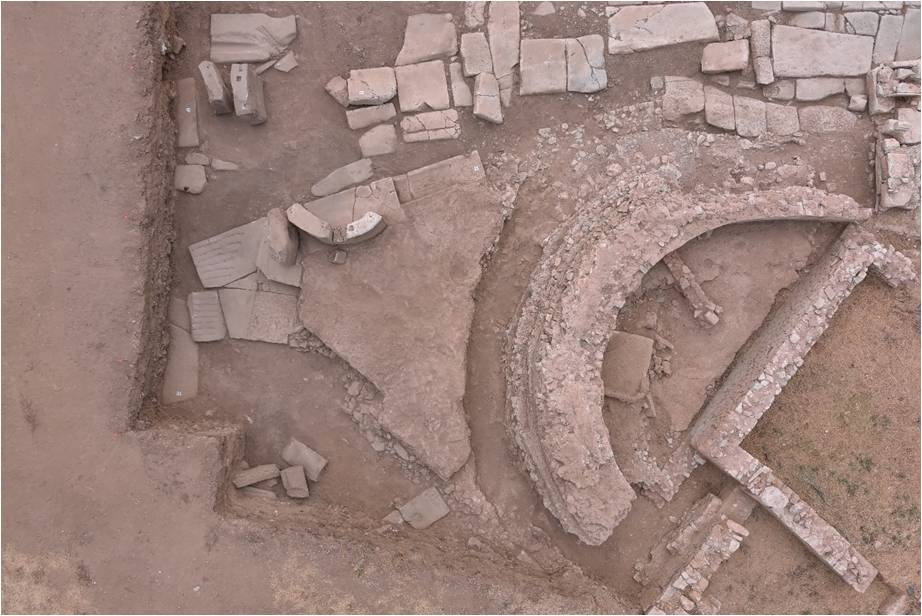
The excavation research conducted by the Aristotle University of Thessaloniki team in Philippi continued in the summer of 2025.
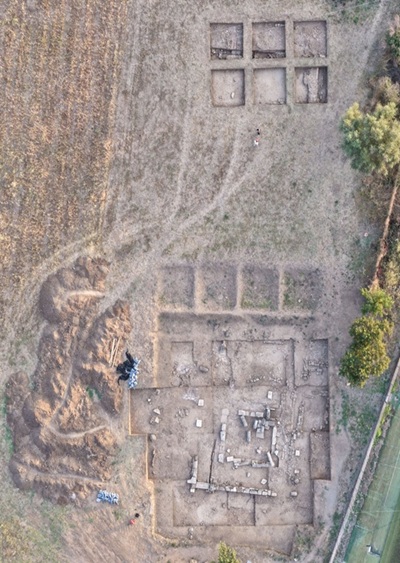
The excavation began with the completion of the excavation in the stoa located on islet 7, south of the southern decumanus – the main road axis of the city. A door was uncovered on the south wall of the stoa, with a marble threshold preserved in situ.
The excavation continued east of the southern decumanus. The continuation of the marble-paved road was identified, as well as the eastern section of the cardo, the perpendicular street that defines the eastern boundary of block 7. East of the cardo, two areas were identified from the next building block to the east. The investigation focused on the complete uncovering of the fountain building, located at the point where the two main roads (north and south deumanus). This year, the entire surface occupied by the fountain structure was identified. In addition, part of the marble paving of the square, which was formed at the point where the two streets converge, was uncovered. A number of marble relief members were found, which formed the water supply points: these are curved marble shields, joined in a concave arrangement. It was possible to replace two pieces in their original position, framing the shield that survives in situ.
This year’s excavation finds mainly consist of pottery, bronze coins, metal objects, and an intact marble basin. Two fragments of inscriptions in Latin were also found. The inscriptions adorned the epistyle, probably of the fountain, and refer to it. The first inscription preserves the following in a series of capital letters: PHILIP. The second inscription survives in two lines, in Latin script and capital letters: the first line preserves the following P·NYMP and the second line REI·PVB.
During the excavation of the southern decumanus, a large marble lion was found in very good condition. Specifically, its head, with its rich mane, and part of its neck and body are preserved intact. The head is turned to its right side. The features of the lion’s head are preserved in excellent condition.
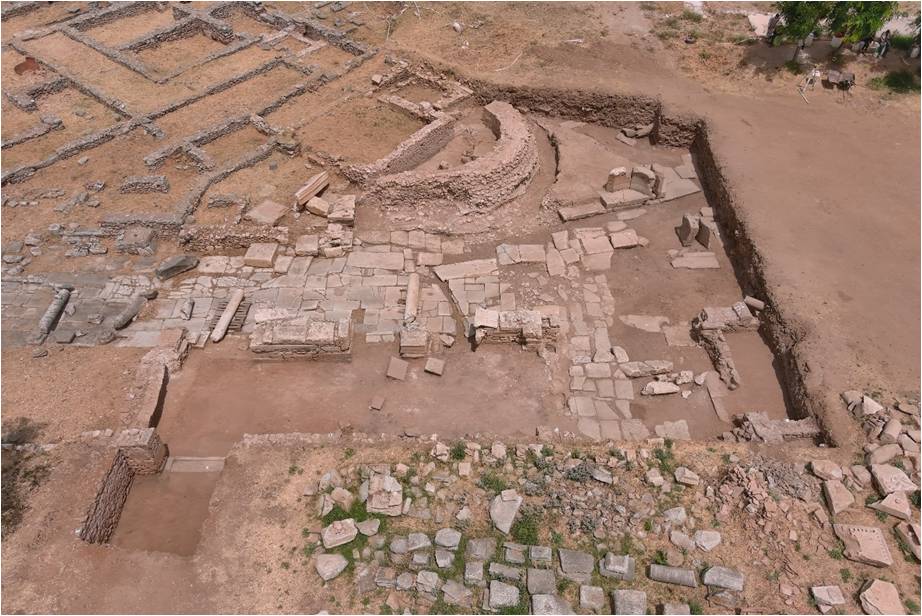
The marble lion is the last impressive sculpture to be found among those that adorned the fountain. Although it probably dates back to the imperial era, it does not seem to match any of the sculptures uncovered in previous years. This observation reinforces the impression that the fountain, although consisting of architectural elements from the Roman period (as indicated by the Latin inscriptions on the architectural members) and sculptures from the same period, has been remodeled and decorated with a collection of disparate elements. This practice is more consistent with a period of historicism in the early Middle Byzantine period, a dating that is reinforced by important structural elements of the fountain, but also by the fact that it has been erected above the slabs where the two roads converge. This point where the two roads meet was certainly remodelled in the early Middle Ages. We have the same picture from the collection of movable finds.
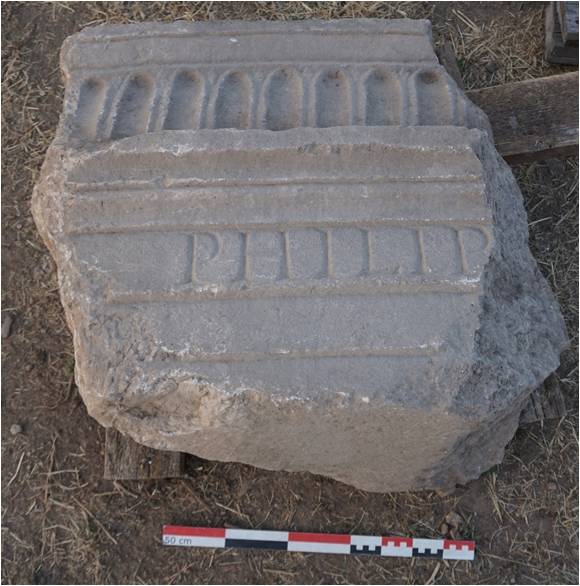
The Inscription
The excavation is directed by Natalia Poulou, professor emeritus of Byzantine Archaeology, with immediate collaborators Anastasios Tantsis, associate professor of Byzantine Archaeology, and Aristotelis Mentzos, Professor Emeritus of Byzantine Archaeology. Members of the excavation team include Nikolaos Theodoridis and Konstantinos-Michail Ganatsas, doctoral candidates in Byzantine Archaeology at Aristotle University of Thessaloniki.
Undergraduate and graduate students from the Department of History – Archaeology at Aristotle University of Thessaloniki, an undergraduate student of Architecture at Aristotle University of Thessaloniki, and an undergraduate student of Archaeology from the University of Paris-Nanterre in France.
The excavation was funded by a grant from RAYCAP.


Leave A Comment