
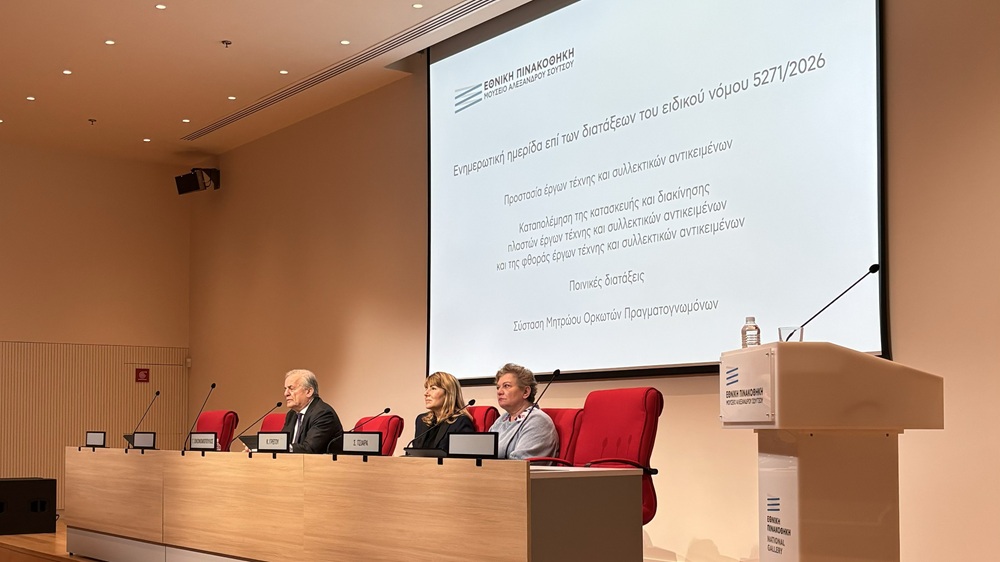
The complex issue of combating the forgery of works of art and collectibles is addressed by Law 5271/2026, “Protection of works of art and collectibles – Combating the manufacture and distribution of counterfeit works of art and collectibles and the damage of works of art and collectibles – Criminal provisions – Establishment of a Register of Sworn Experts – Other provisions of the Ministry of Culture.”
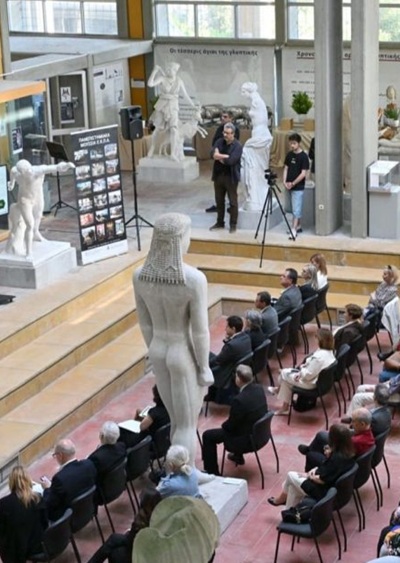
On February 20, Minister Lina Mendoni, National Gallery Director Syrago Tsiara, the artistic director of the EMST, Katerina Gregou, and the legal advisor of the National Gallery Greece-Alexandros Soutsos Museum, George Oikonomopoulos, presented the law and informed the parties involved about the changes that its implementation will bring.
The counterfeiting and trafficking of works of art is a global phenomenon, a lucrative activity often linked to terrorist networks and organized crime, and facilitated by the growth of online sales and the use of artificial intelligence.
As the National Gallery Greece-Alexandros Soutsos Museum Director Syrago Tsiara pointed out: “In our country, it has evolved into an organized, international, and extremely lucrative activity, with serious consequences not only for collectors, museums, and artists, but also for the history of art and institutional memory itself. It is a widespread crime, hidden under the carpet, which we approached in terms of police fiction or action movies…”
The new law is called upon to respond to this reality by introducing some innovations, even at the global level, and filling a gap that existed in Greek legislation.
Law 5271/2026 is a strict law:
The creation, exhibition, possession, donation, and acceptance of donations of counterfeit works are now criminalized, regardless of the financial transaction. Furthermore, even if the owner is acquitted, the counterfeit work is destroyed.
A registry of counterfeit artworks is being created, strengthening international cooperation
One of the most important provisions is the creation of a register of experts and certified appraisers who will be called upon to rule on the disputed authenticity of a work, bypassing the often unreliable attestations and certifications.
Like any law, it remains to be seen whether it will be able to effectively tackle an offense that appears to be growing rapidly on a global scale, especially with the new “arsenal” of high technology.


Leave A Comment