
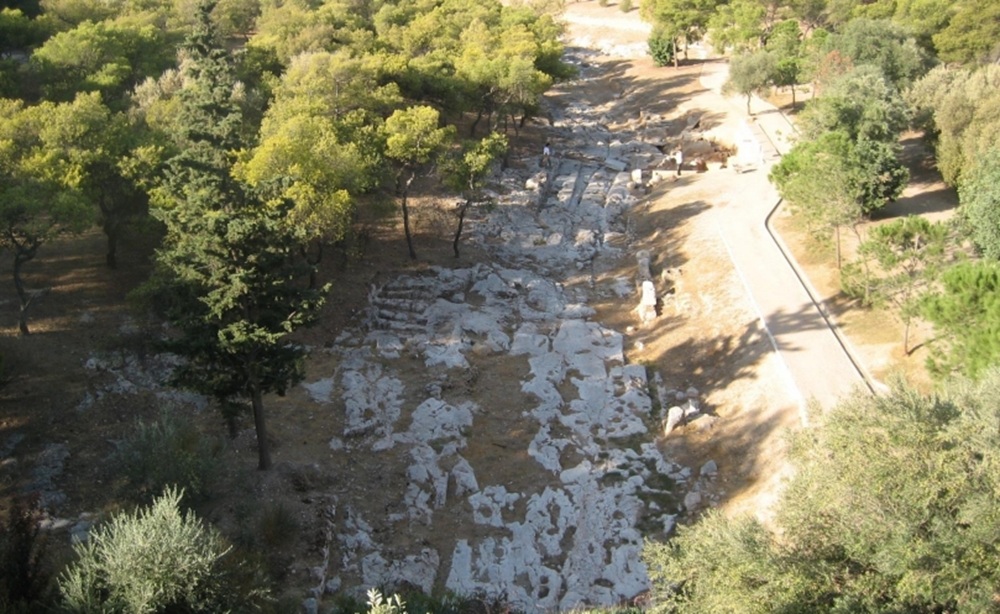
The Ministry of Culture, through the Ephorate of Antiquities of the City of Athens, has included in its strategic plan the promotion of the monuments of the archaeological site of the Western Hills of the Acropolis of Athens—Pnyx, Nymphs, Muses, and Philopappou—as well as the Koile Odos, one of the most important roads of ancient Athens, which runs through the Western Hills. The aim is to functionally integrate the Koilē Odōs into the network of cultural routes of the Acropolis. The basic principles of the intervention are to preserve the authenticity of the monument through the conservation, restoration, and maintenance of the elements that remain unchanged, as well as the restoration of those that have been damaged but can be repaired. Ensuring universal accessibility is also a key priority.
The Minister of Culture, Lina Mendoni, stated: “The Koile Odos is a unique testament to the history, topography, and spatial planning of Ancient Athens, connecting the political, social, and commercial life of antiquity with the modern urban landscape. Its restoration includes monuments and antiquities of exceptional importance, such as the complex of the Church of the Municipality, the monument of Philopappos, the Prison of Socrates, the Kimonion Tombs, as well as shrines dedicated to the Muses, the Nymphs, Pan, and Zeus. With this intervention, we aim to highlight the historical and archaeological value of the monument, protect and promote it, improve accessibility for all visitors, enhance information provision, and create a friendly and safe environment for visitors. The intervention integrates the Koile Odos into the network of routes on the Acropolis and complements the projects to protect and highlight the sections of the Diacheism and the Antiaion Fountain, contributing to the preservation and promotion of the long history of Athens, while enhancing the visitor experience at the major archaeological site of the Acropolis.”
Koile Odos faces various difficulties in terms of maintenance, promotion, and management, such as wear and tear and poor infrastructure, damaged paths and sidewalks, limited access for people with disabilities, lack of adequate lighting and security, environmental pollution and degradation, lack of sanitary facilities and rest areas, inadequate signage and information. The restoration of the Koile Odos involves the protection, promotion, and sustainable management of the archaeological site, with minimal intervention in the landscape. It includes an assessment of the course of the road, excavation and cleaning, restoration and completion of the existing route and the creation of new routes, addressing drainage and slope stabilization issues, and restoring damaged infrastructure. Particular emphasis is placed on accessibility for people with disabilities through appropriate slopes, non-slip surfaces, tactile maps, audio guides, and informational material in accessible formats, while the installation of information signs with accessibility symbols for all users, such as Braille and digital media (QR codes), is recommended. In addition, there are plans to reactivate and reuse the ancient carved rainwater drainage network, which is in very good condition – expropriation and further excavation of important parts of the archaeological site, as well as the use of the routes for educational programs, with the aim of recognizing the geometry and characteristics of the Road and the Municipality it runs through. It is also proposed to improve the signage, lighting, and safety of the site.
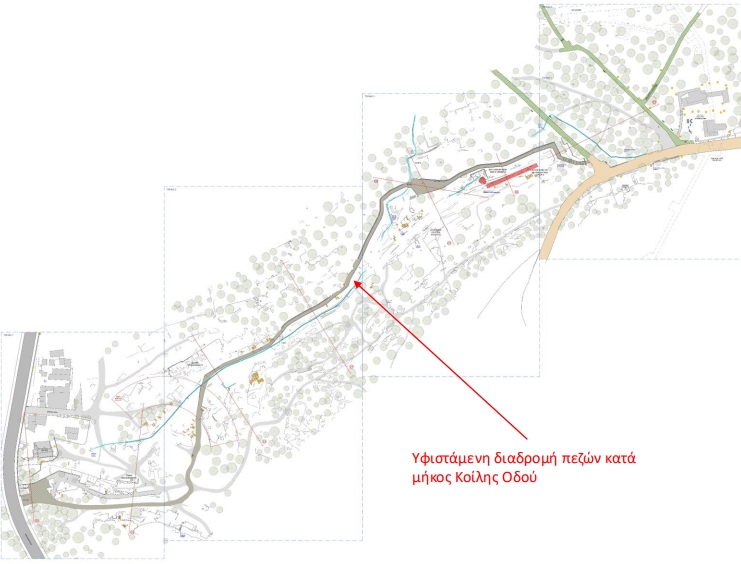
In the archaeological site of the Western Hills, apart from the aforementioned ancient monuments, there are remains of the ancient municipalities of Melitis and Koilis, Byzantine nymphaea, and more recent works, such as the paving and landscaping of Pikionis, as well as the Observatory. The hills have been inhabited since ancient times, and the area developed into a center of political and commercial activity in the 5th and 4th centuries BC, when the municipalities were connected to the ports of Piraeus and Faliro via the Long Walls. An important project of the time was the Diaiteichisma, which limited the perimeter of the Themistoclean wall and included gates of strategic importance for communication with the ports. The ancient Koilidos Street, which crossed the ravine between the hills of the Muses and Pnyx, was a major transportation route, with characteristic deep cart tracks, a carved rainwater drain, and sidewalks with anti-slip grooves.
It is believed that the Agora of the Municipality of Koili was located at the convergence of the hills, with a square, benches, and shops, while in Hellenistic and Roman times the area was converted into a cemetery, dominated by the monument of Philopappos. In more recent years, interventions such as the construction of the Holy Temple of the Transfiguration of the Savior and the Bastia Theater have altered the character of the site. However, between 1997 and 2000, as part of the integration of archaeological sites, work was carried out to highlight the ancient topography, a large section of the Koile Street was uncovered, and the area was organized as a single archaeological and green space. although some sections of the road remain covered or inaccessible, which will be addressed after the completion of the project.



Leave A Comment